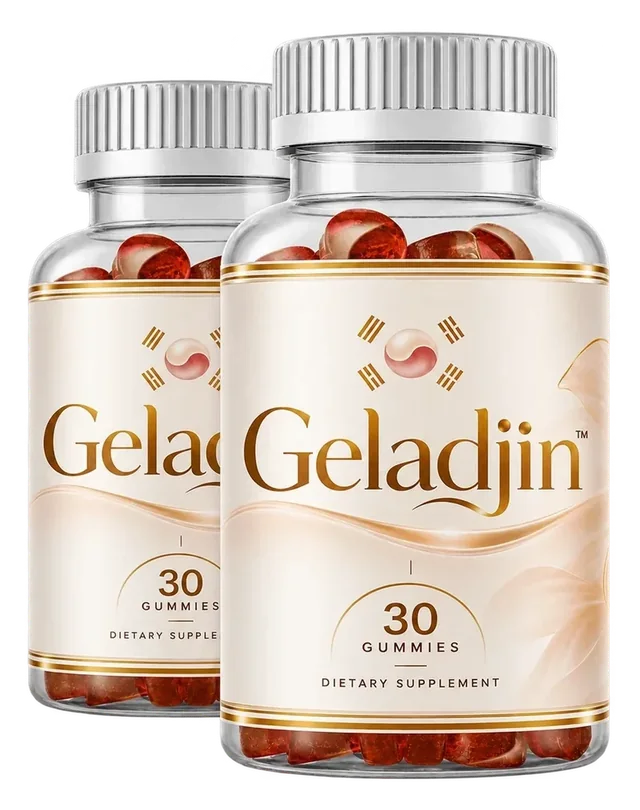
Geladjin ingredients are printed on the Supplement Facts panel of the bottle, and this page reads that panel line by line. As of November 2026, the label lists two active lines, apple cider vinegar and ginger dry extract, plus a short list of other ingredients.1
Everything below comes from the printed label, simple arithmetic on its numbers, or public sources about vinegar and sugar in general. Where the label stays silent, this page says so.
What does the Geladjin Supplement Facts panel show?
The panel shows a serving size of 1 gummy, 30 servings per container, 10 calories, 3 g of total carbohydrates, 3 g of total sugars and 3 g of added sugars.1 Two ingredients are listed with amounts: ginger dry extract at 1 mg and apple cider vinegar at 250 mg.1
| Panel line | Printed amount | Daily Value |
|---|---|---|
| Serving size | 1 gummy | n/a |
| Servings per container | 30 | n/a |
| Calories | 10 | n/a |
| Total carbohydrates | 3 g | 1% |
| Total sugars | 3 g | n/a |
| Includes added sugars | 3 g | 6% |
| Ginger dry extract (root) | 1 mg | not established |
| Apple cider vinegar (5% acetic acid) | 250 mg | not established |
The Daily Value is a reference percentage based on a 2,000 calorie diet, and the label marks it as not established for both active lines.1
What do the calories, carbs and added sugars mean?
One gummy carries 10 calories, and almost all of its carbohydrate is sugar. Total carbohydrates and total sugars are both 3 g, and the label says that all 3 g of sugar is added.1
The 6% Daily Value checks out against FDA's reference of 50 g of added sugars a day: 3 divided by 50 is 0.06.2 FDA calls 5% or less a low source and 20% or more a high source, so 6% sits just above the low line.2 Because the label says "Includes" before added sugars, those 3 g are part of the 3 g of total sugars, not on top of it.2
Cleveland Clinic notes that gummies typically hold 2 to 8 g of sugar per serving and that the sugar and citric acid in gummies can cling to teeth.3 This page makes no claim that the gummy is gentle on teeth.
How much acetic acid is in 250 mg of apple cider vinegar?
If the 250 mg is the 5% vinegar named in the parenthesis, the acetic acid works out to 12.5 mg per gummy. The arithmetic is 250 mg times 0.05, which equals 12.5 mg.1
A tablespoon of liquid vinegar is about 15 mL, which weighs roughly 15 g. At 5% acetic acid, that is about 0.75 g, or 750 mg. Cleveland Clinic describes acetic acid in apple cider vinegar as about 5 to 6 percent.4 Set side by side, 750 mg divided by 12.5 mg is 60, so a tablespoon of 5% liquid vinegar holds about 60 times the acetic acid in that calculation.
Check first: The label does not say how the 250 mg is measured, whether as liquid vinegar, as a dried powder or as another form, and it prints no acetic acid amount in mg. The 12.5 mg figure is arithmetic from the label's own parenthesis, not a printed number.
This matters for reading studies. A University of Colorado endocrinologist says common study doses are one to two tablespoons of vinegar a day, and that most studies test whole vinegar rather than commercial products.5 Because the label prints 250 mg per gummy, those results cannot be applied to this gummy.
What is the 1 mg of ginger dry extract?
The label lists ginger dry extract (Zingiber officinale, root) at 1 mg per gummy, with no Daily Value established.1 That is one thousandth of a gram, and 1 mg is also four times smaller than the 250 mg printed for vinegar on the same panel.
The label does not state an extract ratio or a source of the ginger. This page therefore makes no statement about what ginger does at that amount.
What are the other ingredients?
The label lists eight other ingredients: pectin, cane sugar, tapioca syrup, water, citric acid, sodium citrate, natural flavors and natural colors.1
- Pectin: a plant-based gelling agent, which is why the label calls the product pectin-based.
- Cane sugar and tapioca syrup: the two sweeteners that fit the 3 g of added sugars on the panel.
- Water: the base of the gummy mixture.
- Citric acid and sodium citrate: an acid and its salt, commonly used to set tartness and gel texture in gummies.
- Natural flavors and natural colors: unspecified, as the label gives no further detail.
The NIH Office of Dietary Supplements points out that a product labeled "natural" can still be harmful, so the word is not a safety statement either way.6
What does the Geladjin label not print?
The label does not print an acetic acid amount in mg, a sodium figure, an allergen statement or a manufacturer line beyond the distributor.1 It also carries no free-from or third-party-tested wording, so this site makes none of those claims.1
CU Anschutz suggests looking for third-party seals such as Informed Choice, ConsumerLab, USP or NSF on supplements.5 None of those names appears on the bottle photos studied for this page. Lot and certificate codes from the pack were not verified against the bottle either.
For how the bottle says to use it, see how to take Geladjin. For the safety side, see who should ask a doctor first, and for pack sizes see Geladjin price and where to buy. For all topics, start at the blog index or the Geladjin official website.
Frequently asked questions
What are the main Geladjin ingredients?
The main Geladjin ingredients are 250 mg of apple cider vinegar (5% acetic acid) and 1 mg of ginger dry extract per gummy. The rest is pectin, cane sugar, tapioca syrup, water, citric acid, sodium citrate, natural flavors and natural colors.1
Is the acetic acid in Geladjin 250 mg?
No, the label does not print an acetic acid amount in mg. It prints 250 mg of apple cider vinegar with "5% acetic acid" in parentheses, and 5% of 250 mg is 12.5 mg if the 250 mg is that vinegar. The label does not say how the 250 mg is measured, so read 12.5 mg as arithmetic, not a stated figure.1
How much sugar is in one Geladjin gummy?
Does the Geladjin label list a proprietary blend?
No, the panel lists each active ingredient on its own line with its own amount, and does not use a blend name or a blend total.1 That makes the 250 mg and 1 mg figures easy to read directly.
Should I ask a doctor before using Geladjin?
The label says pregnant or nursing mothers, children under 18 and people with a known medical condition should consult a physician first.1 Questions about this product can go to the contact page.
Sources
- Geladjin bottle label and Supplement Facts panel, as photographed (see the label section on the home page)
- FDA — Added Sugars on the Nutrition Facts Label
- Cleveland Clinic — Do Gummy Vitamins Work as Well as Traditional Vitamins?
- Cleveland Clinic — What Apple Cider Vinegar Can (and Can't) Do for You
- University of Colorado Anschutz Medical Campus — Is apple cider vinegar a health and weight loss tonic? (Sept 2024)
- NIH Office of Dietary Supplements — Dietary Supplements: What You Need to Know (NIH publication 20-OD-8115)